Join us on Facebook, Instagram and Twitter, or read one of our blogs. You’ll find the latest news, photos and videos.
Blogs


This post is also available in:
Română (Romanian)
Enhanced Local Employment Opportunities and Access to Childcare Services for Vulnerable Parents

Keystone Moldova English and Keystone Moldova Romanian
Keystone Human Services (KHS) is a non-profit organization that is a part of a global movement to provide support and expertise to people with disabilities.
For many people with disabilities, access to information, support, and protection is not only a matter of rights, but one of everyday safety. In this context, the hotline service for persons with disabilities operates as a national, rights-based support mechanism, offering more than simple answers—it provides listening, guidance, and intervention when needed.
Available 24 hours a day, 7 days a week, with nationwide coverage, the service can be accessed free of charge by calling 0800 10 808 from any landline or mobile phone. Calls are anonymous and confidential, an essential feature for people facing sensitive or high-risk situations. To ensure inclusion, the hotline also offers alternative communication channels—Viber, SMS, and WhatsApp—specifically adapted to the needs of persons with hearing disabilities.
The hotline goes beyond providing information. It functions as a bridge between people with disabilities, public authorities, social services, the healthcare system, legal actors, and civil society organizations, ensuring that reported concerns do not remain isolated complaints, but are followed by concrete actions.
The hotline is intended for people with disabilities, their family members, professionals working with people with disabilities, as well as community members who may notice difficult or risky situations. This broad approach contributes to the prevention of abuse and enables early intervention.
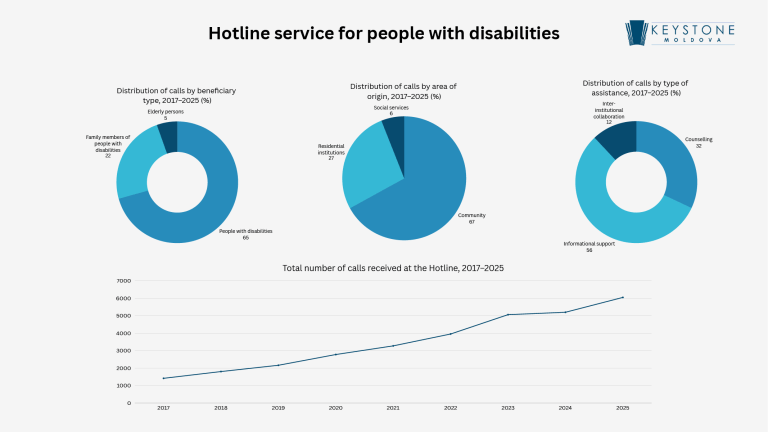
Between 2017 and 2025, the hotline received 31,640 calls, with a steady increase from 1,410 calls in 2017 to 6,042 calls in 2025, a fourfold growth reflects a high level of trust in the service.
Starting in 2022, the hotline also demonstrated its flexibility by responding to emerging humanitarian needs, providing support to 1,657 refugees with disabilities from Ukraine (2022–2025), without reducing access for its primary beneficiaries.
The continuous growth in the number of calls confirms the relevance, quality, and effectiveness of the service, as well as its alignment with the UN Convention on the Rights of Persons with Disabilities. Information is provided in clear, accessible language through a person-centered, rights-based approach that promotes dignity, autonomy, and informed decision-making.
Over the past four years, 54% of callers were first-time users, while 46% were returning users, indicating both successful outreach to new beneficiaries and sustained trust among existing ones. Repeated calls and referrals to other services reflect beneficiary satisfaction and the effectiveness of the support provided.
The management of the service under a state contract since 2019 demonstrates its sustainability and positions the hotline as a replicable model for other countries. Service quality is externally validated through the accreditation of SATGPD by the State Social Inspectorate, in line with the Minimum Quality Standards (Government Decision No. 198/2019).
The accreditation of Keystone Moldova for the periods 2019–2024 and 2025–2030 confirms continuity, accountability, and the safe provision of the service at national level.
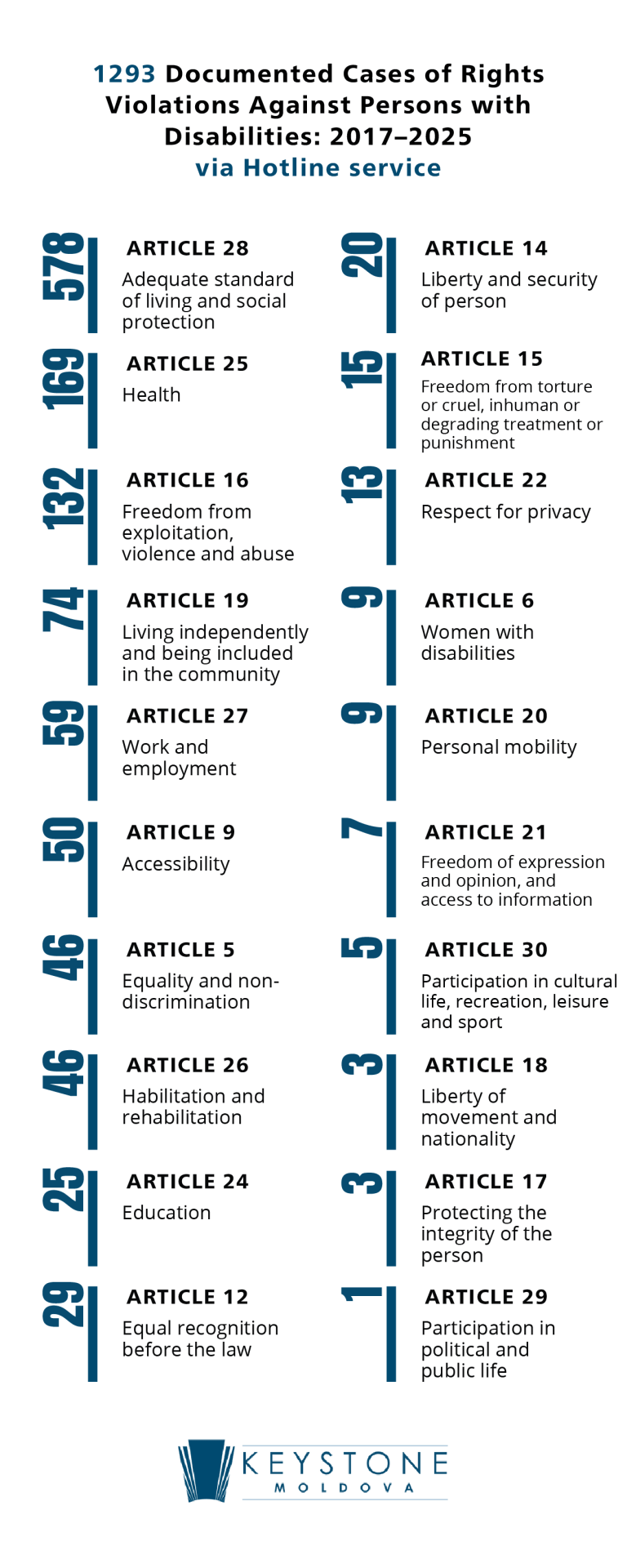
Internally, quality is ensured through systematic monitoring and feedback mechanisms, regular professional supervision, and case reviews. Complex cases involving potential rights violations are monitored for up to three months, ensuring effective interinstitutional coordination and a tangible impact on the protection of beneficiaries’ rights.
Join us on Facebook, Instagram and Twitter, or read one of our blogs. You’ll find the latest news, photos and videos.
Blogs