Join us on Facebook, Instagram and Twitter, or read one of our blogs. You’ll find the latest news, photos and videos.
Blogs



This post is also available in:
Română (Romanian)
Projects

Keystone Moldova English and Keystone Moldova Romanian
Keystone Human Services (KHS) is a non-profit organization that is a part of a global movement to provide support and expertise to people with disabilities.
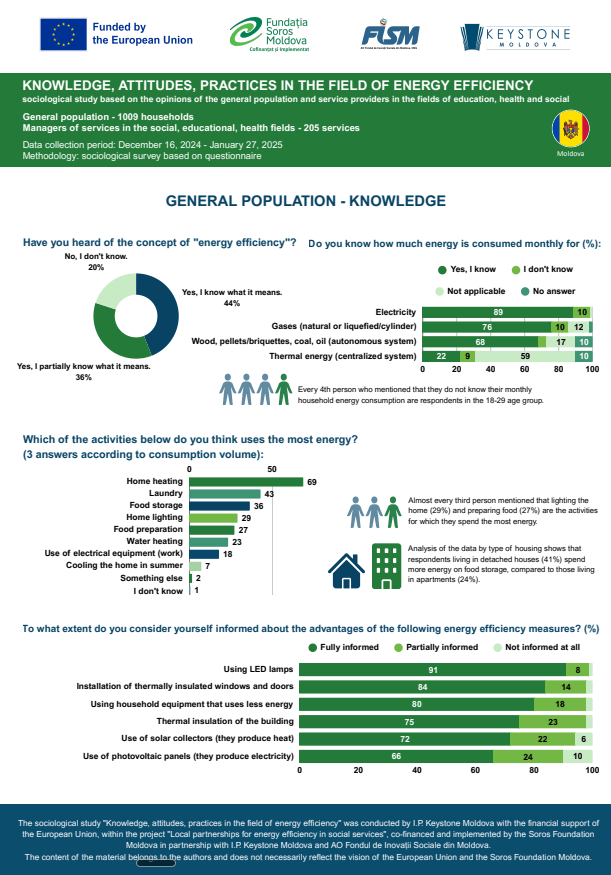
The general population has a relatively good level of information and knowledge about energy efficiency; however, there are significant differences among demographic groups, indicating the need for targeted education and awareness campaigns. The study results show that 44% of respondents state they know what energy efficiency means.
Their knowledge mainly relates to: the physical condition of the home, the state of the electricity and heating systems, the condition of household appliances (which affect energy consumption), and the cost paid without compromising daily comfort.
However, 36% of respondents say they have heard of the concept but only partially understand its essence, suggesting gaps in understanding details, especially regarding the economic impact on households and the ecological impact of energy efficiency. A smaller share of the population associates energy efficiency with behavior toward energy resources and the type of transportation used.
More concerning is that 20% of respondents have never heard of energy efficiency, highlighting a significant information deficit among certain population categories. This finding suggests that some segments either lack access to relevant information or were not included in previous awareness campaigns on energy efficiency.
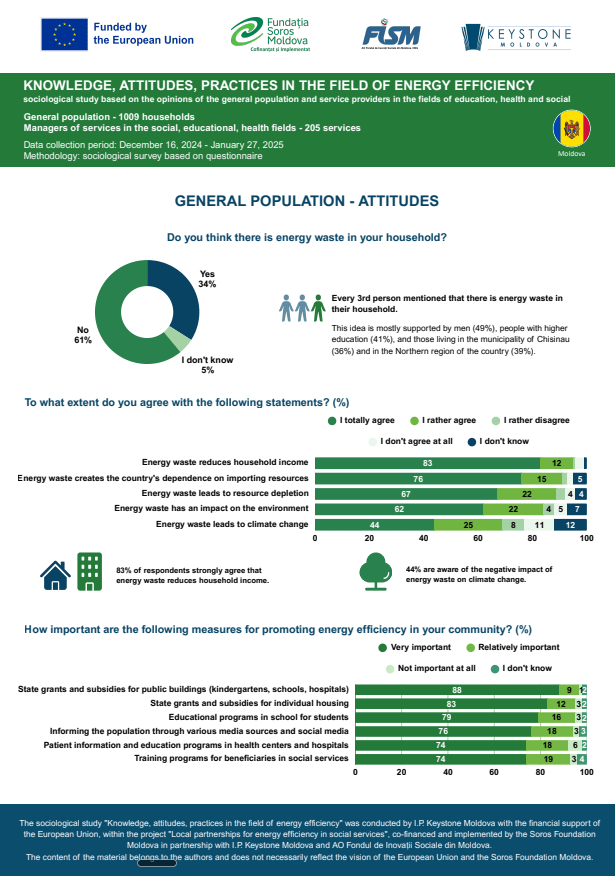
The population’s attitude toward energy resources and adopting energy efficiency measures depends on awareness of energy waste. Most respondents show a responsible attitude toward energy consumption at the household level.
This responsible attitude is driven by energy costs, which directly impact household income. Additionally, about 76% of respondents are concerned that irresponsible attitudes toward energy resources create the country’s dependence on resource imports, and 67% believe energy waste can lead to resource depletion.
A smaller share of the general population is concerned about the impact of waste and irresponsible attitudes on the environment and climate change. Only a relatively small percentage of respondents perceive energy efficiency as a collective responsibility requiring behavioral changes and long-term investment in solutions.
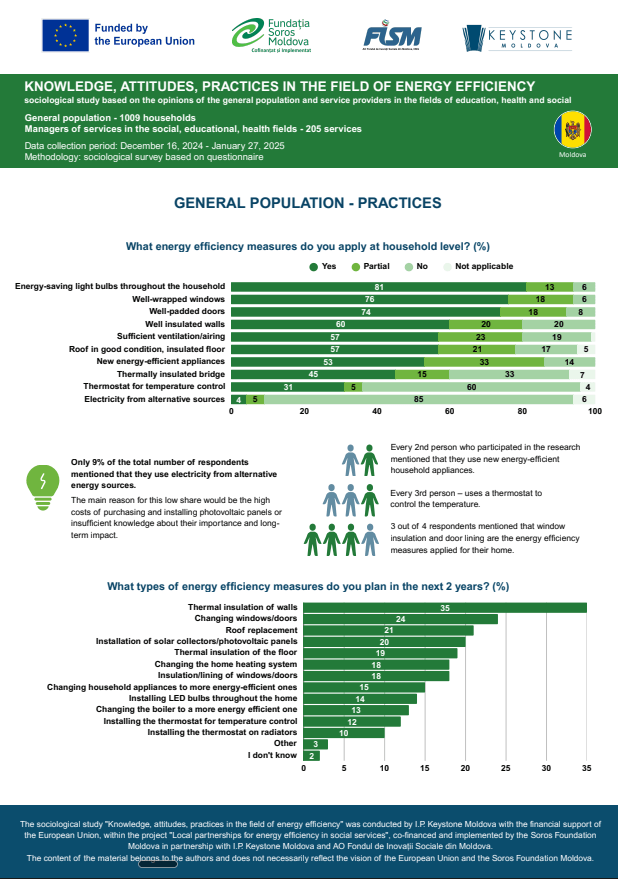
The study emphasizes that energy efficiency is not limited to population knowledge or perception of benefits but also includes the degree of implementation of measures to optimize energy consumption. Although the study shows a relatively high level of awareness of the impact of energy efficiency measures, actual adoption varies significantly depending on initial costs, accessibility of energy-saving solutions, and household financial capacity.
Clearly, low-cost measures with immediate benefits are most frequently adopted, while solutions requiring higher investments are implemented more slowly. This reality highlights a gap between the desire to save energy and the actual ability to do so through significant investments. At the household level, most implemented energy efficiency measures are low-cost. While many households have adopted basic measures such as using LED bulbs (81%) and insulating windows and doors (over 76%), the implementation of more advanced, long-term solutions is limited. Only 4% of respondents use alternative energy sources such as solar or photovoltaic panels, indicating slow progress in transitioning to renewable energy.

Service providers in education, social, and health sectors have a relatively high level of information and awareness regarding energy efficiency: 68% of service managers know what energy efficiency means, but 30% of respondents only partially understand the concept, suggesting gaps in understanding technical details, applicability, and the impact of energy efficiency measures in various contexts.
The level of information on energy efficiency is not evenly distributed across different activity sectors. Education staff is the best informed, suggesting that access to education and specific resources plays a key role in understanding and applying the concept of “energy efficiency.” This confirms the importance of implementing energy efficiency projects and organizing training and awareness activities for service providers focused on innovative solutions, responsible behavior, and sustainability. On the other hand, the health and social sectors are less informed, indicating a greater need for educational programs dedicated to this topic. Staff in these sectors could benefit from specific training to help them understand the advantages of energy efficiency measures and how they can be applied.
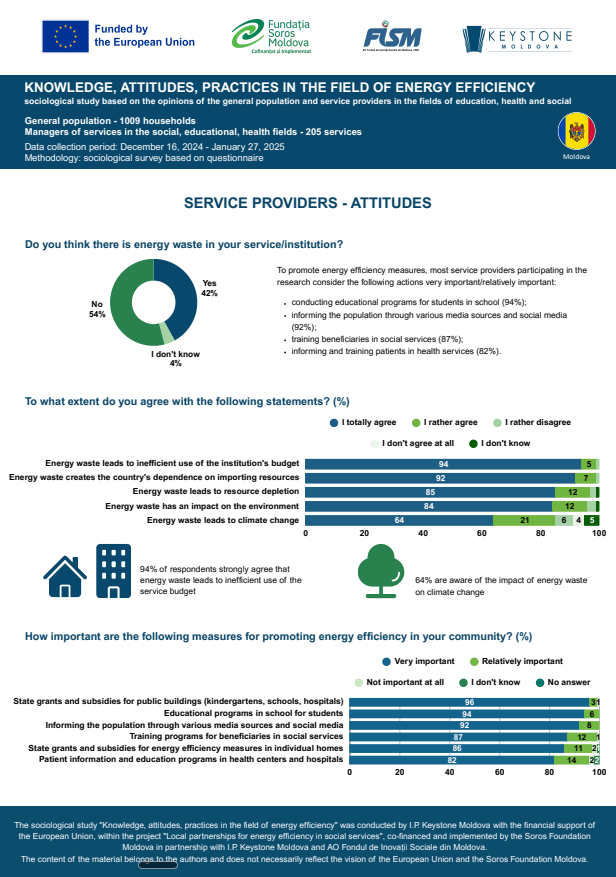
Service providers’ attitudes toward energy efficiency and adopting related measures depend on awareness of energy waste. Despite recognizing the importance of energy efficiency, only 18% of service providers have adopted significant measures in the past two years. Lack of funds and technical barriers are the main obstacles.
The most popular measures adopted are building insulation and using LED bulbs, while more advanced solutions (e.g., photovoltaic panels) are still poorly implemented.
Reducing energy consumption is not a priority in the organizational culture of service providers, and a responsible attitude toward energy resources develops over time based on principles, norms, and organizational values.

Although service providers acknowledge the importance of energy efficiency, actual implementation of measures is limited. Despite 70% of providers considering their buildings partially energy-efficient and 7% considering them not efficient at all, only 18% have implemented concrete energy efficiency measures in the past two years. The most common actions taken are roof replacement (58%), window and door replacement (55%), and LED bulb installation (47%). However, adoption of advanced solutions such as photovoltaic panels (26%) or smart thermostats (13%) remains limited due to high costs and lack of financial support.
The adoption of advanced measures, such as using renewable sources and installing smart equipment, is constrained by high initial costs and insufficient knowledge in the field.
Join us on Facebook, Instagram and Twitter, or read one of our blogs. You’ll find the latest news, photos and videos.
Blogs